
A stocktake tells you what is actually on the shelf, not what the system or your memory says is there. In a cafe or other hospitality venue that means milk, beans, cups, lids, syrups and the dry goods that run out at the worst moment. The method below needs a clipboard or a phone and some discipline, and it gets faster each time you repeat it.
Why count at all?
Ordering from memory is how a cafe ends up with three crates of oat milk and no full-cream. A count shows the gap between what should be there and what is. Small gaps are normal. Large or repeated gaps are the ones to chase, whether the cause is waste, a short delivery or stock that is used but never recorded.
A count is also what makes ordering reliable. Once the shelf numbers are right, the order you place reflects what is there rather than a guess.
When is the best time to count?
Pick a window when the cafe is quiet, usually before opening or after close, and keep it the same each week. Counting through the lunch rush gives you half-counted shelves and cups counted twice. Agree who counts and who records, so one person is not juggling a clipboard and a fridge door at the same time.
If you count after close, freeze the count at that moment. No deliveries should be put away and no stock should be used until the count is finished.
How do you count by storage area?
Walk the cafe in the same order every time: back store, walk-in fridge, under-bench fridges, dry store, then the bar or display. A fixed route stops you missing a shelf, and it makes next week's count quicker.
Within each area, count full and sealed items first, then open ones. Record units, not cartons, unless the carton is the unit you order in. Write the unit beside each product on your sheet so the person counting does not have to guess.
Keep the sheet where the count happens, not on the office desk. It gets filled in as you go, rather than from memory at the end of a long morning.
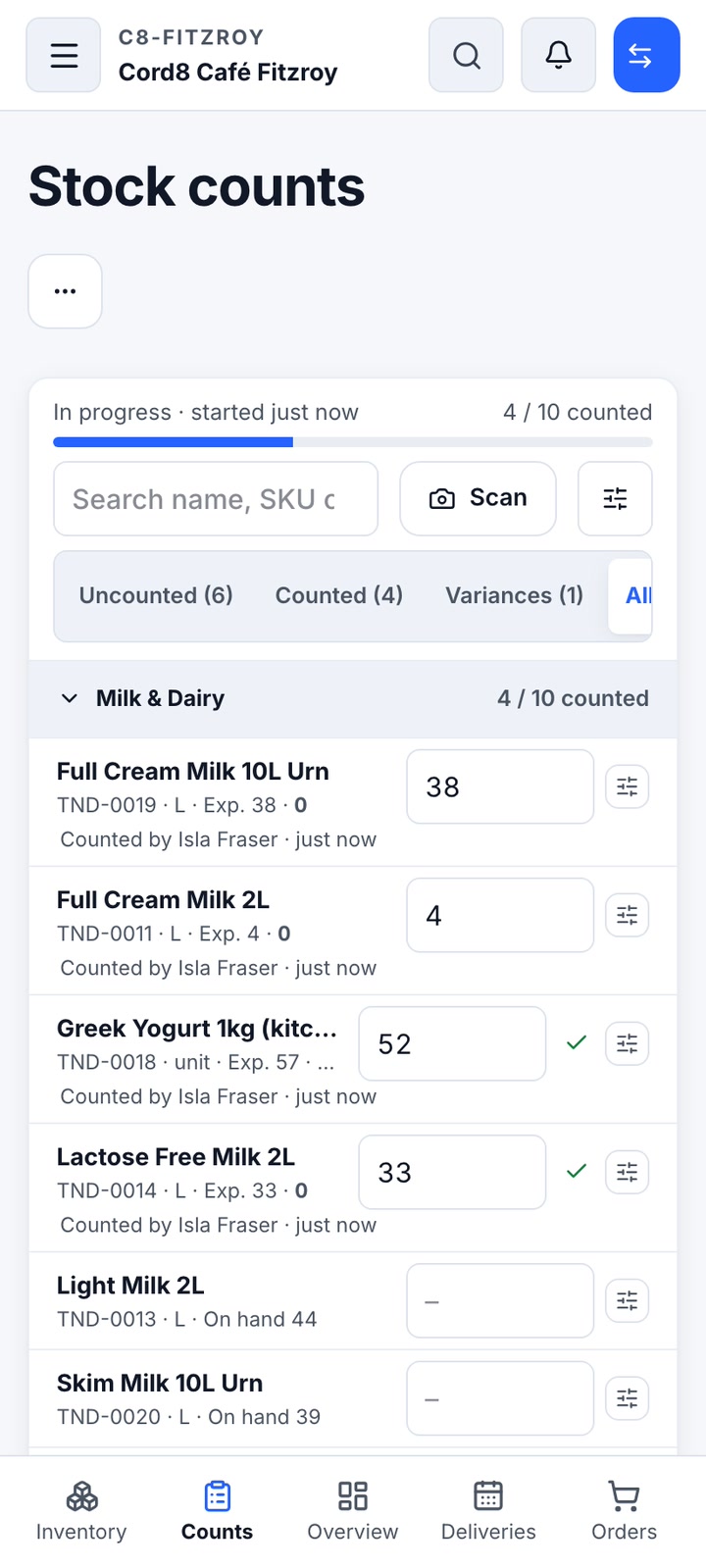
If your team counts on a phone, a barcode scan saves typing a long product name every time.
What should your par levels be?
A par level is the amount you want on hand before you order again. Set one for each product that matters, and start with the items that run out first. Milk, beans and cups usually top the list. Base each par level on what you use between deliveries, plus a buffer for a late run from the supplier.
Keep the par level in the same place as the count, so the count tells you what to order rather than leaving you to remember.
When a product keeps running short against its par level, that is a sign to look at the order, not to count harder. Change the par level, watch the next two weeks, then decide whether it needs another change.
Where are the gaps?
Compare each count with what the records say should be there. Check high-value items and the things you count most often first. Then look for patterns. A product that is short every Monday usually points at a process, such as a weekend delivery that is put away without being recorded, rather than at one person.
Before you change a number, recount the line. Many gaps turn out to be a unit mix-up, a delivery that was never received in the system or a count written on the wrong row. A gap that survives a recount is the one worth a conversation.
Keep a short note beside any gap you recount, even when it turns out to be nothing. Over a few weeks those notes show whether the problems sit with a product, a supplier or a particular part of the week.
If stock is leaving through the bin rather than being used, the date tracking guide for cafe waste covers that side of the same problem.
How often should you count?
The first full count is always the slowest. Treat it as your baseline, and after that the weekly counts only need to cover what moves.
A full count once a month is too slow for a cafe with fast-moving milk and bread. Do a short weekly count of the items that move most, and a full count every month or whenever you change suppliers or your menu. Use the same sheet each time, so the numbers line up from one week to the next.
For counts, orders and gaps in one place, see inventory software for independent shops and venues. If you run a cafe specifically, cafe rostering and stock covers the same routine alongside your roster.
Stocktake checklist
- Choose a quiet count window, and keep it the same each week.
- Walk the cafe in the same order every time.
- Count units, and note the unit beside each product.
- Set a par level for every product that matters.
- Recount any gap before you change a number.
- Note the deliveries and waste that happened during the count.
- Review the gaps, then order against them.
Common questions
How long does a cafe stocktake take?
There is no fixed time. It gets quicker once the route, the sheet and the window are the same every week. A short weekly count of your fastest-moving items is much quicker than a full monthly count, so keep the two separate.
Should I count during trading hours?
You can, but the shelves need to be still. Pause deliveries, use the same window every time and count from the back forward. Counting in the middle of service is where double counts and missed shelves come from.
What do I do with a gap I cannot explain?
Recount the line first. Then check whether a delivery, a waste record or a transfer is missing for that product, and look at the same product over the last few counts. If the gap keeps returning, look at the process around it, such as receiving and who has access to the storage area.